Showing posts with label World War 2. Show all posts

21 July 2011

The Maritz Rebellion

At the end of the Boer War in 1902, all Boer soldiers had been asked to sign an undertaking that they would abide by the peace terms. Some, like Deneys Reitz, refused and were exiled from South Africa. Over the following decade many returned home, and not all of them signed the undertaking upon returning. At the end of the Boer War those Boers who had fought to the end were known as "bittereinders" ("bitter enders"); by the time of the rebellion, those who had not taken the oath and wanted to start a new war had also become known as the "bittereinders".

The outbreak of hostilities in Europe in August 1914 had long been anticipated, and the government of the Union of South Africa was well aware of the significance of the common border South Africa shared with the German colony of South-West Africa. Prime Minister Louis Botha informed London that South Africa could defend itself and that the imperial garrison could depart for France; when the British government asked Botha whether his forces would invade German South-West Africa, the reply was that they could and would.

South African troops were mobilised along the border between the two countries under the command of General Henry Lukin and Lieutenant Colonel Manie Maritz early in September 1914. Shortly afterwards, another force occupied the German port of Lüderitz.

When the South African government had offered to invade the German colonies, the commander-in-chief of the Union Defence Force General Christiaan Beyers resigned, writing "It is sad that the war is being waged against the 'barbarism' of the Germans. We have forgiven but not forgotten all the barbarities committed in our own country during the South African War", referring to the atrocities committed during the Boer War. A nominated senator, General Koos de la Rey (who's grandmother was Johanna Elizabeth Du Buis/De Buys), who had refused to support the government in parliament over this issue, visited Beyers. On 15 September they set off together to visit Major JCG (Jan) Kemp in Potchefstroom, who had a large armoury and a force of 2,000 men who had just finished training, many of whom were thought to be sympathetic to the rebels' ideas.

Although it is not known what the purpose of their visit was, the South African government believed it to be an attempt to instigate a rebellion, as stated in the Government Blue Book on the rebellion. According to General Beyers it was to discuss plans for the simultaneous resignation of leading army officers as protest against the government's actions, similar to what had happened in Britain two years earlier in the Curragh incident over the Irish Home Rule Bill. On the way to the meeting General de la Rey was accidentally shot by a policeman at a road block set up to look for the Foster gang.

The Foster gang was a group of criminals who operated around Johannesburg and the Rand, during 1914. The gang, led by William Foster, committed various acts of robbery and murder. After a stand off with the police, the gang members and Foster's wife all committed suicide.

At General de la Rey's funeral, however, many Nationalist Afrikaners believed and perpetuated the rumour that it was a government assassination, which added fuel to the fire; this was even further inflamed by Siener van Rensburg and his controversial prophecies.

Jan Kemp, unknown rebel, Manie Maritz at Keetmanshoop in "German West"
General Maritz, who was head of a commando of Union forces on the border of German South-West Africa, allied himself with the Germans and issued a proclamation on behalf of a provisional government which stated that "the former South African Republic and Orange Free State as well as the Cape Province and Natal are proclaimed free from British control and independent, and every White inhabitant of the mentioned areas, of whatever nationality, are hereby called upon to take their weapons in their hands and realize the long-cherished ideal of a Free and Independent South Africa." It was announced that Generals Beyers, De Wet, Maritz, Kemp and Bezuidenhout were to be the first leaders of this provisional government. Maritz's forces occupied Keimoes in the Upington area. The Lydenburg commando under General De Wet took possession of the town of Heilbron, held up a train and captured government stores and ammunition. Some of the prominent citizens of the area joined him, and by the end of the week he had a force of 3,000 men. Beyers also gathered a force in the Magaliesberg; in all, about 12,000 rebels rallied to the cause. The irony was that General Louis Botha had around 32,000 troops to counter the rebels and of the 32,000 troops about 20,000 of them were Afrikaners.

The government declared martial law on 14 October 1914, and forces loyal to the government under the command of General Louis Botha and Jan Smuts proceeded to destroy the rebellion. General Maritz was defeated on 24 October and took refuge with the Germans. The Beyers commando was attacked and dispersed at Commissioners Drift on 28 October, after which Beyers joined forces with Kemp, but drowned in the Vaal River on 8 December. General De Wet was captured in Bechuanaland, and General Kemp, having taken his commando across the Kalahari desert, losing 300 out of 800 men and most of their horses on the 1,100 kilometre month-long trek, joined Maritz in German South-West Africa, but returned after about a week and surrendered on 4 February 1915.

After the Maritz rebellion was suppressed, the South African army continued their operations into German South West Africa and conquered it by July 1915.

The leading Boer rebels got off relatively lightly with terms of imprisonment of six and seven years and heavy fines. Two years later they were released from prison, as Louis Botha recognised the value of reconciliation. After this, the "bittereinders" concentrated on working within the constitutional system and built up the National Party which would come to dominate the politics of South Africa from the late 1940s until the early 1990s, when the apartheid system they had constructed also fell.

Source:
http://www.wikipedia.com
http://en.vionto.com/show/me/Maritz+Rebellion
Picture: http://streamsandforests.wordpress.com/2010/02/14/deneys-reitz-in-wwi-the-maritz-rebellion/

20 June 2011

Alfred De Buys

I'm trying to find out more about Alfred De Buys and his ancestors...
Alfred De Buys (Around 1950)
Alfred De Buys was born in Middleburg on 03 August 1899 (although some documents show other possible birth dates we assume this to be correct) and died of a heart attack on 20 November 1966. He was a labourer before he joined the military where he assumed full time duty 28 August 1941. Alfred served as a chef in the Cape Corps.

His military papers reveal the following:


01/10/1941 - 05/10/1941Hospitalized with bronchitis
30/12/1941Left for Suez with the 2nd SAA
18/12/1941Disembarked Suez
06/10/1942Placed on x4 list from 7th Squadron
1942Injured during bombings in Tobruk, Libya
12/11/1942Placed on GL EX 2 F P
10/03/1943Promoted to T/H Cpl with P & A
01/02/1944Posted to NEAS DEP
23/02/1944placed on x2 list - hospital
(Chest? unclear)
10/03/1944Struck of x2 list
17/02/1945Left Suez for Union


Record of the Medals that Alfred was to receive

Alfred was awarded the following medals:
  • 1939-45 Star
  • Africa Star
  • Defence Medal (British)
  • The War Medal 1939 - 45
  • Africa Service Medal
  • 8th Army Clasp

Alfred's discharge papers states that he was suffering from chest pain and pain in his legs.

After the war Alfred married Rachel De Bruyn (born 1898/11/02, Richmond, died ~1979).  Alfred had 4 sons and 3 daughters.

If you have any information with regards to Alfred's family and or military career I would love to hear from you!

06 April 2011

Pieter Johannes De Buys' World War 2 Movements

Pieter Johannes De Buys

Pieter Johannes De Buys was born on 21 April 1915 at Daspoort, Transvaal, South Africa. He died on 05 July 2003 in Potchefstroom, South Africa. Pieter is my grandfather, left home at a very early age and joined the South Africa Defence Force as painter.  Through years of service Pieter was promoted and, in 1935, he was posted at the SAA Castle in Cape Town and was serving as a Bombardier.

On 05 February 1938 Pieter was hospitalized for an injury sustained while serving in the  1st Heavy Battery. On 27 August 1939 he was moved from 1 Heavy Battery, Cape Artillery Battery (CAB), to the 4th Heavy Brigade, Durban Garrison Artillery (DGA).

Pieter was promoted to a Lance Bombardier on 01 July 1940). He was then transferred to the Cape Peninsula Artillery Brigade on 12 February 1941 from the First Batallion, Durban.

Pieter was transferred to SATE on 19 March 1943 and embarked from Durban with the Pretoria Regiment and arrived in the Suez Canal on 30 April 1943.

He departed for Egypt on 30 May 1943.  The 6th South African Armoured Division spent a year in Egypt training. Training began in the desert at Khataba, north west of Cairo and was focused on tank operations and integrating the Rhodesian elements into the division.


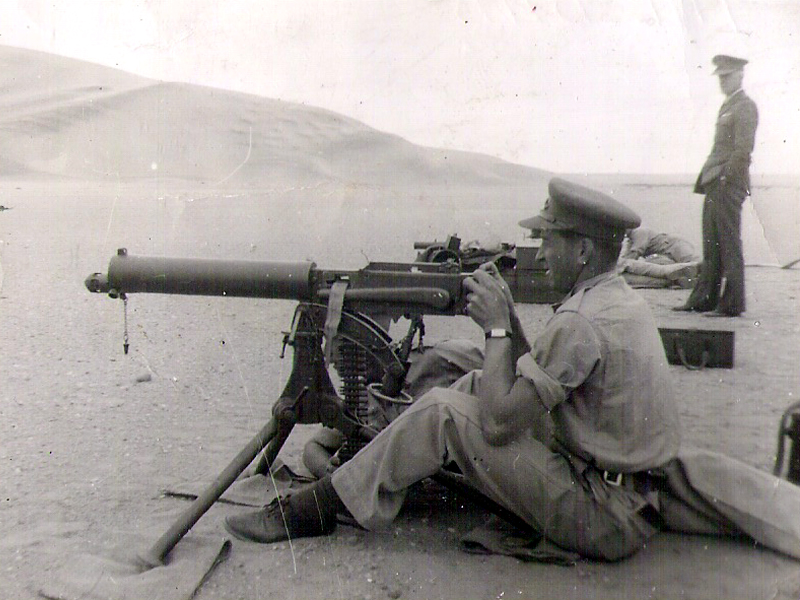
This picture must have been taken at Khataba, north west of Cairo between 30 May 1943 and 3 March 1944.  The weapon that Pieter is using is a Vickers heavy machine gun.  It was used by the British during World War I, Chaco War, World War II, Indo-Pakistan War of 1947, 1948 Arab–Israeli War, Korean War and the Congo Crisis.
From 22 September 1943 to 01 October 1943 Pieter was placed on the x2 list and hospitalized with sandfly fever. He was discharged from hospital and taken of the x2 list on 01 October 1943.  He rejoined the Pretoria Regiment upon being discharged.

On 01 September 1943 he was granted the War Substantive Rank of Corporal. (A War Substantive Rank is a rank which may revert at the end of war, the holder will then revert to previous rank held)

On 30 October 1943 Pieter was sited for contravening Section 40 (1) of the Military Disciplinary Code.  This was for a minor offence contrary to the good order and military discipline.

On 11 May 1944 he was transferred from 6th South African Armoured Division to the South African Artillery Corps

Pieter was crossposted from 6th South African Armoured Division (prov. coy (v)) to the South African Corp Of Military Police (SACMP) on 24 May 1945.

On the 09 September 1945 he left Italy for Egypt and remained there until March 1946.

Pieter was admitted to hospital with tonsilitis and placed on the x2 list on 20 September 1945 and released on 27 September 1945, but was re-admitted, this time with scabies, on 05 October 1945 and stayed until 20 October 1945 (Each discharged note states that he was taken off the x2 list upon leaving the hospital.)

On 10 March 1946 he disembarked in Durban, South Africa and reported to the Provincial Department Showgrounds in Pretoria on 12 April 1946

Pieter was awarded the 1939/45 Star, The Africa Star, the Italy Star, the Defence Medal (British) and the War Medal (1939/45)

Many thanks to Marc Norman, Graham C. L. Du Toit and Audrey Portman
 

Sources:
http://en.wikipedia.org/wiki/6th_Armoured_Division_%28South_Africa%29
http://www.rothwell.force9.co.uk/6SAdiv.htm
http://orbat.com/site/ranks/rankexplanation1.html

14 March 2011

6th South African Armoured Division


A while ago while my parents were still flea marketing they came across an interesting framed map in one of their buys.

It was a framed map of Italy with insignia's of several brigades who had served in Italy during World War 2. Because I was researching my De Buys genealogy and the fact that we had known that my grandfather, Pieter Johannes De Buys (born 21/04/1915, died 05/07/2003), had served in Italy during World War 2 they gave me the picture.

I stored the picture intending to investigate it again at some stage.

Many months later I was going though some of the items I have stored pertaining to the family and I saw the framed map again. By that time I had received documentation from another family member giving Pieter's service records during World War 2. I got goosebumps when I looked at the insigna's and realized that my grandfather had served in the 6th South African Armoured Division which is a the head of the brigades indicated on the map!

The South African 6th Armoured Division was the first armoured division in the South African Army and was formed during World War II.

This division, the first true armoured division in South African military history, was formed in South Africa on 1 February 1943 from new recruits and units that had served in the 1st, 2nd, and 3rd SA Infantry (and Armoured) Divisions.

It was based on a nucleus of men from the former South African 1st Infantry Division who had returned to South Africa after the Second Battle of El Alamein. The Division was initially transferred to Egypt for training, after which the division landed at Taranto, Italy on 20 April 1944. In Italy, the Division was deployed as part of the British Eighth Army and was then transferred to the United States Fifth Army for the remainder of the Italian Campaign. The Division operated as a strongly reinforced division and was frequently used to spearhead the advance of the Corps and Army to which it was attached.

Despite leading the advance on Rome, the division was denied the honour of "taking" the city (entering the city first) by the United States Army. “However, the division was one of the first allied units to enter Florence two months later. The division's active role in the war ended when the German forces in Italy surrendered on May 2, 1945. Major General WHE (Evered) Poole was the sole divisional commander during its existence.

They returned home after the end of the war in Italy and were disbanded in 1946.

Sources:
Wikipedia
DefenceWeb